Let’s be honest: traditional gyms aren’t for everyone. They can be crowded, expensive, and smell like a mix of cleaning chemicals and old sweat. Plus, when the sun is finally shining, the last place you want to be is stuck inside a windowless room running on a conveyor belt.
That’s why more people are taking their training outside.
Whether you call it a “calisthenics park,” a “trim trail,” or just “working out at the park,” training outdoors is one of the best ways to get fit. It’s free, the air is fresh, and the view is definitely better than the back of someone’s t-shirt.
But I get it—walking up to those metal bars in the park can feel awkward. You might feel like everyone is watching (they aren’t), or you might just stare at the equipment and wonder, “What am I actually supposed to do with this?”
This guide is here to help. No fluff, no jargon—just a straightforward breakdown of how to get a great workout outside, what you need to bring, and how not to look like a total rookie.
Why Bothers Training Outside?
Aside from saving fifty bucks a month on a membership, there are some actual physical and mental reasons to swap the treadmill for the trail.
1. It’s Better for Your Brain
There’s a concept called “Green Exercise.” Basically, researchers found that exercising in nature lowers stress way faster than exercising indoors. It’s a two-for-one deal: you get the physical benefits of the workout, plus the mental reset from being around trees and grass. If you’re stressed from work, 30 minutes in the park does a lot more for you than 30 minutes under fluorescent gym lights.
2. The Ground Isn’t Perfect (And That’s Good)
Gym floors are perfectly flat and rubberized. The real world isn’t. When you do lunges on grass or run on a dirt path, the ground is slightly uneven. This forces all those tiny stabilizer muscles around your ankles and knees to fire up to keep you balanced. It builds “real world” strength that machines just can’t replicate.
3. You Get Some Sun
Most of us spend way too much time indoors. Outdoor training gets you some Vitamin D. Just don’t forget the sunscreen.
The Gear: What You Actually Need
One of the best things about outdoor training is that you don’t need much. You don’t need a parachute or a weight vest to get started. However, because there’s no locker room or front desk, you do need to prep a little.
Here is the essential kit:
-
The Right Shoes: Leave the flat casual sneakers at home. You need grip. Grass gets slippery, especially in the morning. Wear running shoes or cross-trainers with a decent tread.
-
A Water Bottle: Public fountains are usually broken or gross. Bring your own water.
-
Sun Protection: A hat and sunglasses make a huge difference. Squinting into the sun while trying to do push-ups is a headache waiting to happen.
-
A Towel or Mat: This is key. You’re going to be on the ground for core work. You don’t want to be lying in mud, ant hills, or whatever the local dogs left behind. A cheap yoga mat or an old towel is fine.
-
Hand Protection (Optional but Recommended): Outdoor pull-up bars are usually made of steel. In the summer, they get hot and sweaty; in the winter, they freeze. Plus, they can be rough on your hands. A simple pair of gloves or some liquid chalk can help you hold on longer.
Understanding the Equipment
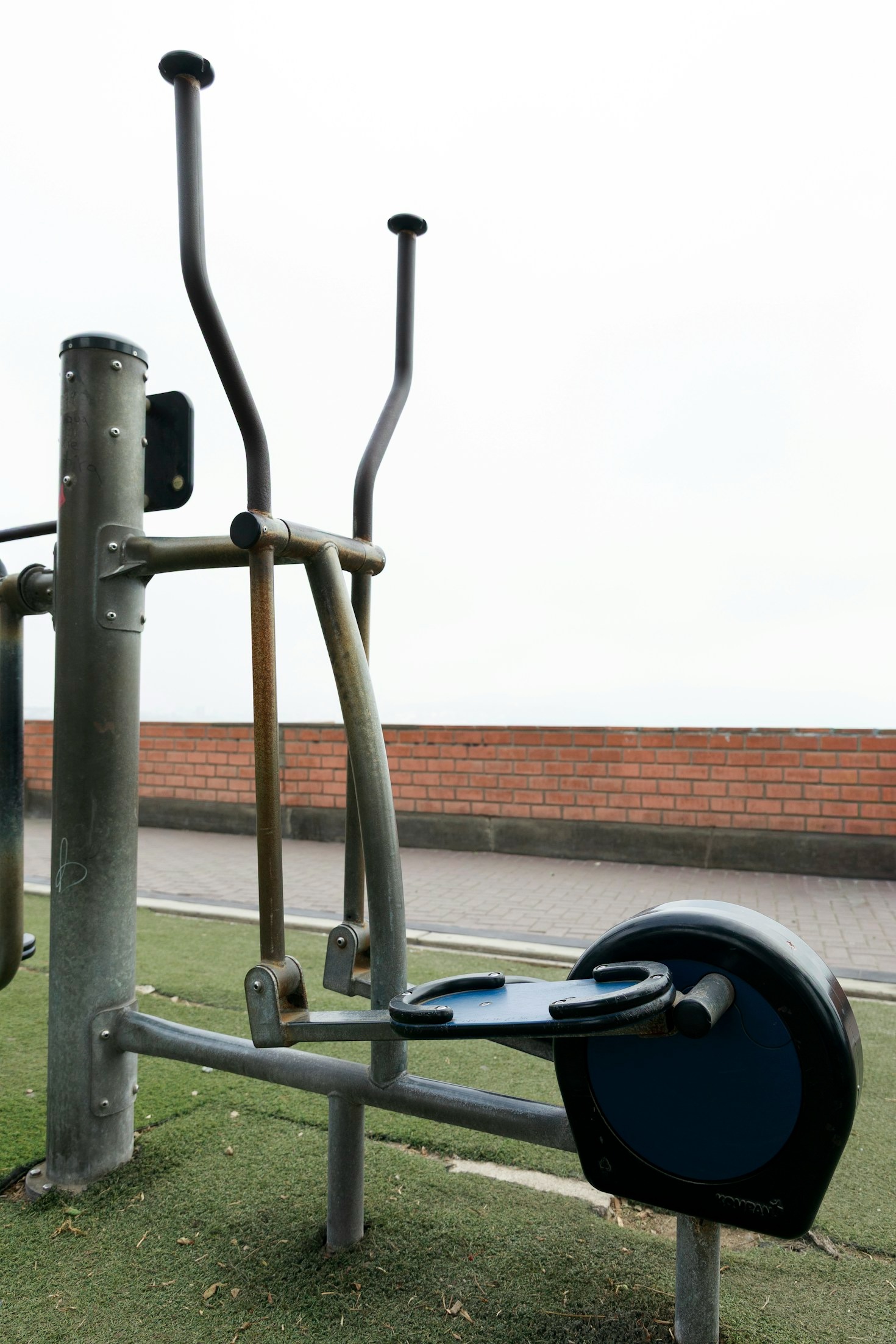
If you walk into an outdoor gym, you’ll usually see a few standard pieces of equipment. They look a bit abstract, but they correspond to standard gym movements.
The High Bar It’s just a pull-up bar.
-
Use it for: Pull-ups, chin-ups, or just hanging to stretch your back and build grip strength.
-
Can’t do a pull-up? No worries. Jump up, hold yourself at the top for a second, and lower yourself down as slowly as possible. That’s called a “negative,” and it’s the best way to learn.
The Low Bar This is usually waist or chest height. It’s probably the most useful tool for beginners.
-
Use it for: Incline push-ups (easier than the floor) or “Australian Pull-ups” (body rows). This is where you hang under the bar with your feet on the ground and pull your chest up. It works your back without needing the strength for a full pull-up.
Parallel Bars Two bars next to each other.
-
Use it for: Dips. These are great for triceps and chest.
-
Beginner tip: If dips are too hard, just support your weight on your hands with straight arms. Holding yourself up builds shoulder stability.
The Bench Just a standard park bench.
-
Use it for: Step-ups, box jumps, or tricep dips (with your hands on the seat).

The “No-Nonsense” Park Workout
You don’t need a complicated spreadsheet for this. We’re going to do a Circuit. This means you do one exercise, move to the next, and only rest once you’ve done them all. It keeps your heart rate up and saves time.
The Plan: Do 1 set of each exercise. Rest for about a minute or two. Repeat 3 times.
1. Warm-Up (Don’t skip it)
You aren’t in a heated room, so your joints might be cold. Spend 5 minutes moving.
-
Jog in place or run a lap around the park.
-
Swing your arms in big circles.
-
Do some torso twists.
-
Swing your legs forward and back to loosen up the hips.
2. The Circuit
Exercise A: Incline Push-Ups
-
Why: Works your chest and arms.
-
How: Put your hands on a park bench or a low bar. Step your feet back so your body is straight. Lower your chest to the bar, then push back up.
-
Reps: 10 to 15.
-
Too easy? Do them on the ground.
Exercise B: Bodyweight Squats
-
Why: The king of leg exercises.
-
How: Feet shoulder-width apart. Sit back like you’re sitting in an invisible chair. Keep your heels on the ground and your chest up. Stand back up.
-
Reps: 15 to 20.
Exercise C: Australian Pull-Ups (Body Rows)
-
Why: You need to pull things to balance out all the pushing. This works your back and biceps.
-
How: Find a waist-high bar. Slide under it. Grab the bar, keep your body straight and heels on the ground. Pull your chest up to the bar.
-
Reps: 8 to 12.
-
Too hard? Bend your knees and put your feet flat on the ground.
Exercise D: Step-Ups
-
Why: Great for glutes and balance.
-
How: Find a bench (make sure it’s stable). Step up with your right foot, bring the left foot up to tap the bench, then step down with the left. Switch legs.
-
Reps: 10 on each leg.
Exercise E: The Plank
-
Why: Core strength protects your back.
-
How: Get on your mat/towel on the grass. Elbows on the ground, toes on the ground. stiffen your body like a board. Squeeze your stomach muscles. Don’t let your lower back sag.
-
Time: Hold it for 30 to 45 seconds.
How to Make Progress (Without Weights)
In a gym, when you get stronger, you just pick up a heavier dumbbell. Outside, you don’t have that luxury. You weigh what you weigh. So, how do you keep getting fitter?
1. Change the Angle This is simple physics.
-
If push-ups on the bench are too easy, move to the ground.
-
If push-ups on the ground are too easy, put your feet on the bench and hands on the ground (Decline Push-up).
-
The more horizontal you are, the heavier gravity feels.
2. Rest Less If you rested 90 seconds between rounds last week, try resting 60 seconds this week. Doing the same work in less time forces your body to adapt.
3. Slow Down Don’t rush your reps. Try taking 3 full seconds to lower yourself down into a squat or push-up. It burns way more, which means it builds more muscle.

Common Mistakes to Avoid
If you’re new to this, watch out for these pitfalls.
Checking Your Phone Too Much It’s easy to get distracted outside. Watching a dog run by or checking texts kills your workout intensity. Put the phone on “Do Not Disturb,” put on a playlist, and get the work done.
Ignoring the Surface Always look where you are stepping or putting your hands. Uneven turf can twist an ankle, and nothing ruins a workout faster than putting your hand in something sharp (or gross) hidden in the grass.
Thinking People Care This is the big one. Beginners often feel self-conscious doing lunges in a public park. Here is the truth: nobody cares. The runners are focused on their breathing, the parents are watching their kids, and the other people working out are just focused on their next set. You have every right to be there.
Basic Etiquette
Even though there are no staff members to yell at you, there are still unwritten rules.
-
Share the Bars: If you are resting between sets, step away from the equipment. Someone else might want to sneak in a set while you catch your breath.
-
Check the Equipment: Before you put your full weight on a bar, give it a shake. Public parks can suffer from wear and tear. Make sure it’s solid before you hang from it.
-
Keep it Clean: If you brought a water bottle or a wrapper, take it with you. Don’t be the person who litters in the park.
The Bottom Line
Outdoor workouts don’t have to be complicated to be effective. You don’t need to be an expert in calisthenics or a parkour athlete. You just need to be willing to sweat a little bit in public.
It might feel different at first compared to the climate-controlled environment of a commercial gym, but that’s the point. You’re moving your body the way it was designed to move, in the environment it was designed to be in.
So, grab your water bottle, head to the nearest park, and give that circuit a try. It’s simple, it’s free, and it works. Find a pull-up bar or outdoor gym near you to get started.
Leave a Reply